Howdy, y’all!
In my neck of the woods, next week is officially “Week Two.” If you ask me, Week Two is the real heavyweight champion of the back-to-school season. It is a massive week packed to the gills with Open House, parent notifications, and getting students set up in our online learning platform. All the while, you are going over the course syllabi, continuing with your tableside reading conferences and diagnostic assessments, running to school-wide meetings, and hopefully, finally putting that last poster up on the wall or organizing all the things you packed away back in June. I can only imagine that for you, just like for me, Week Two tends to be rather hectic.
Continuing with my thread on what to do at the beginning of the school year, I’ve been thinking a lot about how I communicate with parents and how I get them to inform me about the unique needs of their students. This year, I am having the absolute pleasure of hosting a student teacher—this will be my fifth one! It is always a wonderful challenge figuring out what to get them to do while helping them understand the teenage mind. Reflecting on my own routines has forced me to look at the practices I do naturally as a seasoned veteran teacher that a newer educator might not think to do. In fact, I started talkin’ about it with one of my peers—who has actually been teaching even longer than me—and they confessed they don’t do these things either!
So, I wanted to share a few tips on how I connect with families and build a true community that supports the student learners in our classrooms.
1. The “In a Million Words or Less” Assignment
One of the very first things I do is send home a single, simple piece of photocopied paper. At the very top, it has a basic block for the student’s name and their class period. (At my school, we are on a 90-minute block schedule. I teach three classes a day and have one planning period to collaborate, meet, do all the wonderful things teachers do, and hopefully grade somewhere in between.)
Right below that name block, I title the page: In a Million Words or Less, Tell Me About Your Child.
I send this lined sheet home and tell my students that their homework isn’t to get a syllabus signed or fillin’ out a dry contact log. Instead, their homework is to hand this to their adult and say, “Tell my teacher about me.” I make it clear that if a parent doesn’t speak English, they are more than welcome to write in their native language. If they want to write the words down but have their student dictate it, that is just alright too. If the parent would prefer to just email me the response, that’s okay also. I just need it back by a specific date.
Once these letters start rollin’ back in, it is absolutely eye-opening. I learn things about the student that the online portal will never tell me, such as:
- The student actually lives with a grandparent or an older sibling.
- They have struggled in English for a very long time.
- They are a dedicated athlete or are working a part-time job late into the evening.
- Or, a parent might simply write, “She’s okay,” as their entire response.
I’ve had parents tell me about the exact day their child was born, details about their personality, how they prefer to be corrected, or how they are split between two households because of a divorce. It gives me incredible insight into the worlds these kids go home to. These are high school students, mind you—not elementary kids—but parents are still so excited just to know that a teacher cares enough to ask for their perspective. It tells me how high their standards are for their student’s achievement, how relaxed they might be, and even what kind of writers the parents are. You can learn a lot from what family will tell. The beauty of this is that 99.9% of the time you get the kindest, sweetest letters from parents about how interesting their students! And, they always tell you the truth.
2. The Proactive “Good News” Phone Call
During that exact same week, I pick up the phone. I make it a goal to call the parent of every single student on my roster.
If none of the numbers listed in our online attendance system are working, I will pull the student aside the next day and say, “Hey, I tried calling home yesterday to say hi but couldn’t connect. Do you think we could call your parent together real quick just so I can introduce myself and give them my contact information?” If there is a language barrier, like a family that speaks Spanish or Vietnamese, doing a quick co-call with the student is a fantastic bridge.
On these brief calls, I introduce myself, give them a quick run-through of the classroom expectations, and let them know that my tutoring sessions are always held on Wednesdays.
Making this brief connection makes a world of difference because it ensures the very first phone call a parent gets from the school is not a bad one.
In the hectic world of teaching, it is incredibly hard to find the time to make positive phone calls, so parents are conditioned to expect bad news about grades or behavior whenever the school’s caller ID pops up. Startin’ the year with a simple, pleasant conversation changes the whole dynamic. It lets them know you view them as a partner in their child’s success.
3. Open House Bribery (Yes, Really!)
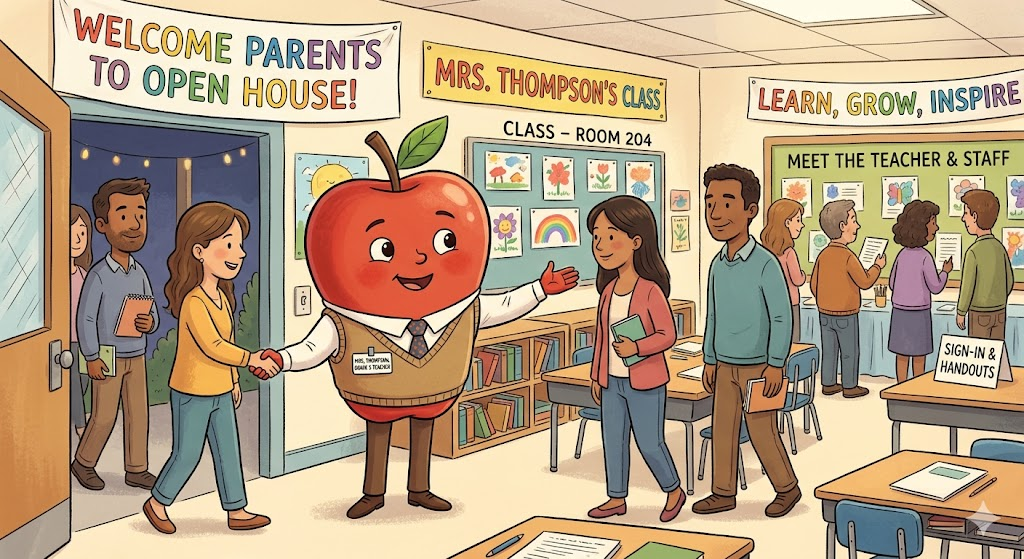
The final tip I have for Week Two is to highly encourage parents to attend Open House. It is the easiest opportunity to meet face-to-face and see your classroom environment head-on.
To get them there, I am not above a little shameless student bribery. I tell the kids that if they bring their parent to meet me and shake my hand, I will give them an incentive. Sometimes it’s a few raffle tickets for our classroom rewards system, or dare I say, an assignment pass they can use to get out of a minor assignment or spend a chunk of class reading in the library once their required work is finished.
It’s a small token, but it gives the students a reason to drag their parents to school. It creates another vital touchpoint with the family, and I often get to meet siblings or other family members who didn’t write the letter or answer the phone call.
Expanding Your Village
There is immense power in getting to know the families of our students. This doesn’t mean you are going out to dinner with them or agreeing to show up to every single weekend event, but it does mean you are visible. It means you aren’t afraid to call home for the good things just as much as the bad things.
Let’s face it: it takes a village to teach a student and help them grow. But as teachers, we have to remember that while the village for us is the school building, the village for the student includes the baseball field, the football stadium, the band room, the theater, the orchestra, and their after-school job at Staples or Chick-fil-A. It’s the home they spend the other 14 hours of the day in.
We need to step outside our four walls and get to know the full village. If you haven’t done it lately, I highly recommend taking a drive around the community your school serves. You don’t need to look up individual student addresses—absolutely not—but get to know the area. See where they hang out, look at the neighborhoods, see the restaurants, and look at what the community is doing.
And finally, show up.
I always try to attend at least one athletic event for every single sport each school year, and I try to make it to all the arts events at least once. Being present and being seen matters. It shows your students and their families that you aren’t just a talking head for 90 minutes a day—you are a true stakeholder in their community and a genuine partner in their success.
Let me know if y’all try out any of the suggestions in the comments or feel free to send me some ideas of what you do to build community via email.
Until next time, y’all take care.


Leave a Reply