Howdy, y’all!
Let’s be completely honest for a minute: those first 10 days of school are a whole lot more than just a challenge. I don’t know about how things work in your neck of the woods, but in my school district, those first two weeks are the absolute days of change. They are the days of enough students bein’ rescheduled that you spend time catching them up before you can move on with the entire class. It can be frustrating.
Now, that might just be because my school is absolutely massive. So perhaps it’s just my neck of the woods, but I have a feelin’ even the smaller schools face this same 10-day shuffling act. It’s not just new students transferrin’ in from out of state or from a neighboring county; it’s the counselors desperately trying to balance out course numbers so you don’t end up walkin’ into a classroom of 45 students for an honors or AP course.
Scheduling is always and forever gonna be a thorn in our side at the beginning of the year. The only blessed thing you can do is welcome those kids into your room with a big smile, treat ’em like an honored guest in your home, and pray that the scheduling gods sort it all out eventually.
That being said, I know some teachers love to hand out the syllabus on day one and dive headfirst into the heavy course content by day three. But the truth is, between the ever-changing roster, grade-level assemblies with administration, and counselors popping in to chat about graduation requirements, nothing runs on time and people are constantly showin’ up late. Plus, you’ve got a stack of attendance lists and paperwork a mile high for the county and the front office that absolutely cannot be avoided. You have to do ’em, just like you have to go over the fire drill exit plan and explain the basic protocols and procedures that keep your room from devolving into pure madness—especially if you’re teachin’ freshmen who don’t know the first thing about being a high school student yet!
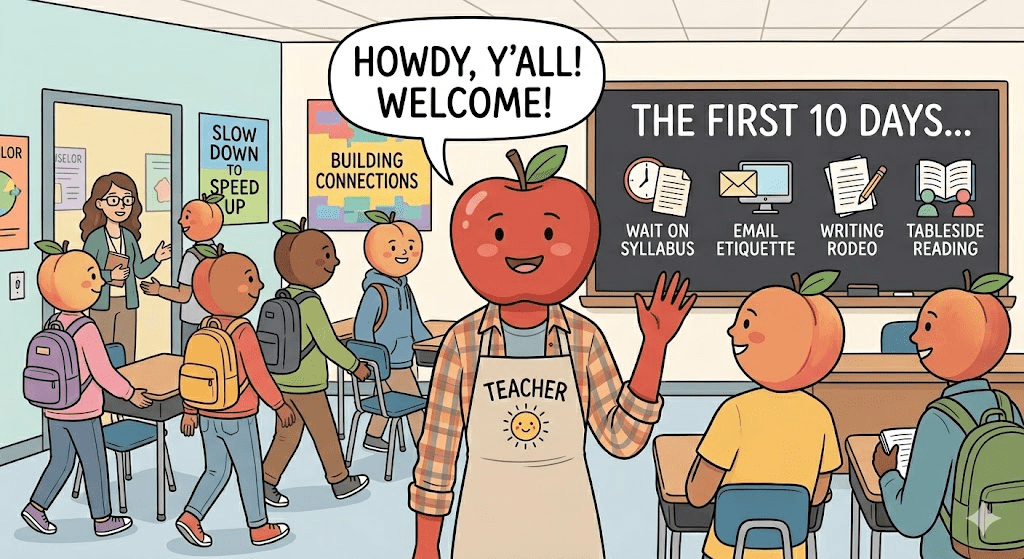
Why I Wait to Hand Out the Syllabus
Because of all that shifting sand, I wait. I don’t send home a syllabus until all the schedules are officially locked down. I will send home a basic classroom supplies list so parents know what to grab at the store, and if it’s an Advanced Placement or honors class, we will have a serious chat about why the expectations look a whole lot different than an on-level course. I tell ’em to go home and have an honest conversation with their folks: Do you really feel like taking on this mountain? Do your parents think you’re ready for the challenge? Sometimes, that conversation itself causes a much-needed schedule change, and that’s okay. Other times, it sets the tone for how parents can support their students, and how students can navigate the class. This of course is not a chance to get kids out of your class, it is a chance to chat about what is real and what their needs are.
I am sure by now in this blog read you are wondering: “but what on earth do you do with those kids for 10 whole days while you’re waitin’ for the dust to settle? You can’t just sit there, stare at ’em, and fill out paperwork.”
Instead, think about what you can do to truly understand the learners sitting in front of you. And bless your heart, I am not talkin’ about more icebreakers, get-to-know-you games, or forced team-building activities. I’m talkin’ about what you can do instructionally to figure out how to help them grow.
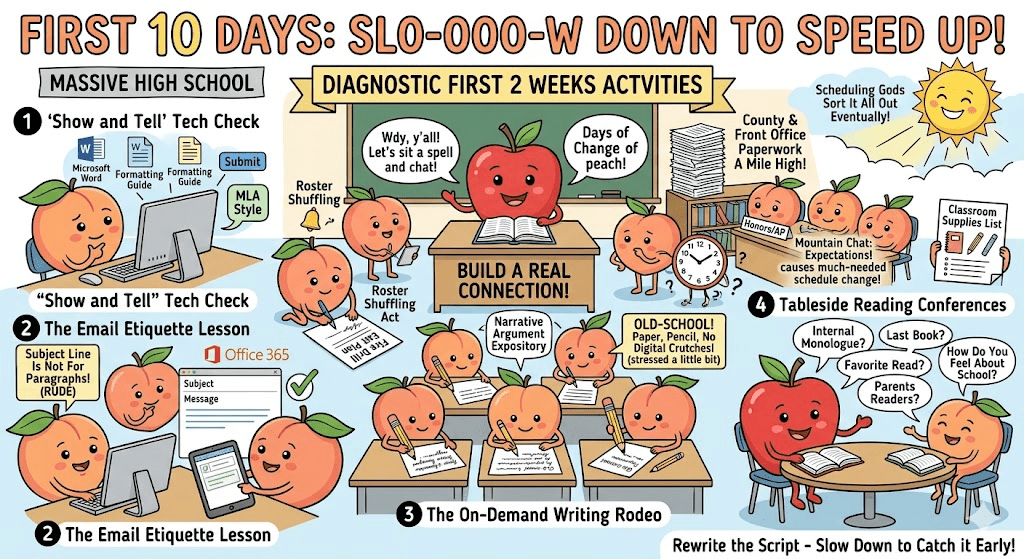
Here are four diagnostic activities I run during the first two weeks to find out exactly where my kids are at before the real curriculum hits the fan:
1. The “Show and Tell” Tech Check
One of the first things I do is see whether or not these kids actually know how to use a computer properly. Can they navigate Microsoft Word? Do they know how to format a formal paper?
I use an activity called “Show and Tell,” and it’s a little old-school. I give them a step-by-step list of specific formatting tasks to complete in Word. The final product has to look a very specific way, and then they have to submit it to our online platform. Now, facing the ever-dreaded issues with AI and plagiarism software these days, you just have to hope they’re gonna be honest and do the work correctly. If my collective observations show me that half the class can’t even find the margins or change a font, then guess what? I adjust my lesson plans for the next couple of days and teach ’em how to use the software properly so they don’t struggle later. (Here is a direct link to this free resource: https://docs.google.com/document/d/1UxXvG9FmY3i_o-nFbe_ZBf-cLDoG48jK/edit?usp=sharing&ouid=102315533819635649888&rtpof=true&sd=true)
2. The Email Etiquette Lesson
The second activity I absolutely love to do is teaching ’em how to send a proper email. You would be shocked at how many students—even seniors!—have no earthly idea that our county purchased them an Office 365 account, let alone how to find it or attach a document to it.
I spend at least one or two lessons on this, mostly so I can teach ’em how to not sound incredibly rude to me in my inbox. Over the years, I have gotten countless emails that read exactly like a rushed text message, or where they write the entire paragraphs-long message directly into the subject line! To avoid that headache, I show ’em what a professional email looks like, we walk through the steps, and they choose from a few templates to write and send an email directly to me. It gives me a perfect baseline of their typing skills and their understanding of professional communication.
3. The On-Demand Writing Rodeo
Since I am an English teacher, I want to see them write in every single style—narrative, argument, and expository. And to make it a true diagnostic, I stress ’em out just a little bit: we do it old-school with paper and pencil. No laptops, no phones, no digital crutches allowed.
These kids have been in school long enough to know how to respond to a prompt. They’ve written essays in English, social studies, and science classes for years. But can they write on demand, right then and there on the spot? I want to see what their independent writing looks like, and honestly, I want to see if their handwriting is even legible! I don’t want to find out that a student can’t string a sentence together five weeks into the semester when I’m grading a major unit essay. We do generic prompt-based writing and some short passage-based analysis right up front because I need to see where they are starting from so I can get ’em to where they need to be.
4. Tableside Reading Conferences
Our county requires us to do some multiple-choice reading assessments to get a baseline Lexile score, and that’s fine and dandy. But I am old-school—I need to actually hear them read out loud.
Starting in the second week, once things calm down a hair, I start running oral reading assessments while the rest of the class is working on their writing or their tech check. I love using a quick three-minute oral reading assessment. It takes no time at all, but it lets me sit down with a student one-on-one for a tableside chat.
During these little conferences, we have a real conversation about reading. I ask ’em:
- Do you have an internal monologue? Can you hear yourself reading silently, or do you have to whisper the words under your breath?
- When was the absolute last time you read a whole book?
- What is the favorite thing you’ve ever read in your life?
- Are your parents readers? Do you read at home at all?
These quick conversations tell me so much about who they are, how they feel about school, and what their foundational skills look like. It lets me feel out their personalities and build a real connection before the pressure of grades sets in. I’ll even have ’em peer-review each other’s early writing pieces during this time just to listen to how they talk to one another—are they mean, are they rude, or are they way too generic with their feedback? I want to know it all up front.
Slow Down to Speed Up
Taking this time during the first 10 days means nothing is a surprise to me later on. It won’t be a shock in October when Johnny or Billy Bob can’t write on the lines correctly. You’ll already know if you have an 11th grader who writes floating in the air between the lines, puts the holes of the loose-leaf paper on the right side instead of the left, or doesn’t know how to put a proper MLA name block in the upper right-hand corner. Let’s be real—reading and writing are not innate traits; they are skills that have to be explicitly taught. If they’ve been getting away with bad habits up to this point, we have to rewrite the script, and we can’t do that if we don’t catch it early.
Now, that’s not to say we don’t look at the syllabus eventually, or that we won’t be absolutely scrambling in December tryin’ to finish our final unit because we took things slow in August. We all know that end-of-semester scramble is a very real thing! But sometimes, you have to slow down in order to speed up.
So, I challenge you to think about it as you prep for the upcoming school year: What are you gonna do with your first 10 days? Are you a day-one syllabus pro, or a day-two novel-reading machine? Think about your pacing, figure out what actually works for your sanity, and try slowing things down this year. See what happens—after all, what can it hurt?
Until next time, y’all take care.


Leave a comment