Howdy, y’all!
Let’s sit a spell and talk about a little something that can completely flip the script on how your classroom runs from day one: classroom rules versus classroom protocols.
Now, look—when you’re first startin’ out in those initial couple of years of teachin’, you absolutely need clear-cut, defined boundaries. You’ve got to know what you’re gonna tolerate and what you’re not, which makes total sense. Being clear about where things go, when students can speak, and what time they can head on over to the restroom is just basic survival. We need boundaries and limitations to establish what is acceptable behavior and what just won’t fly.
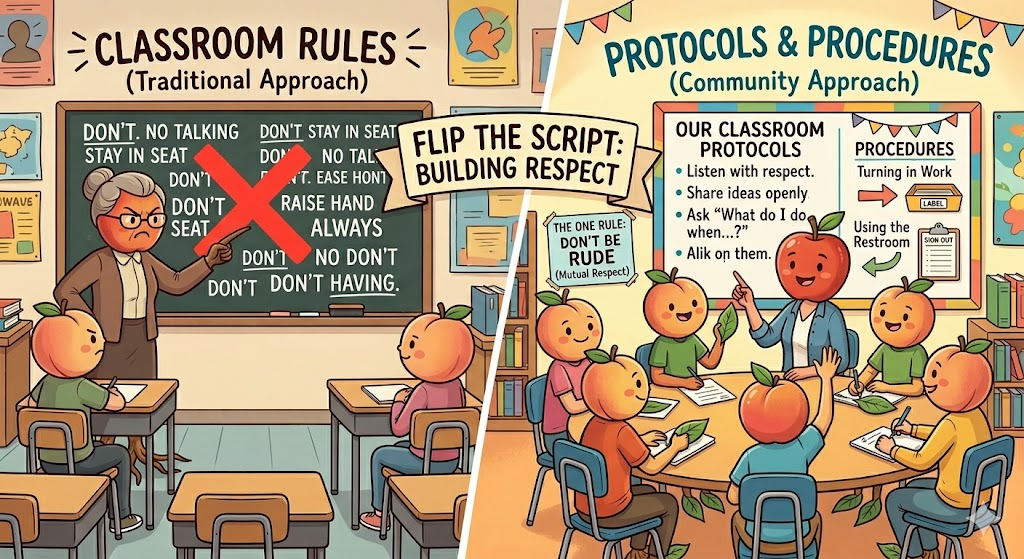
But bless their hearts, here’s the honest truth: callin’ these classroom maneuvers “rules”—especially when you’re dealing with middle or high school students—doesn’t actually train them for the real world. In fact, it usually just ruffles their feathers.
That’s why I don’t use the word “rules.” It instantly sets an authoritarian, “I’m the boss” tone in your classroom before you even get your feet under you. Instead, I call them protocols and procedures.
The One Exception: The Don’t Be Rude Conversation
Now, I do have one unwritten rule that I actually call a rule (well sometimes ….lol…), and it is beautifully simple: Don’t be a jerk. (Some years, I’ll soften it up a bit and say, Don’t be rude.)
On the very first day of school, we have a real, open conversation about what “rude” actually means:
- What does it look like?
- What does it sound like?
- How do we know when we’re acting rude, and how do others know?
- What qualifies as rude for me as the adult, and what is rude for them as the students?
We talk about mutual respect and the power of being able to say, “Hey, that’s not okay,” to a peer or even directly to me. I tell my kids the absolute truth: I don’t mind bein’ wrong, and I don’t mind apologizing if I do something that interferes with how they’re feeling.
My job isn’t to put ’em down or make them feel beneath me; my job is to teach them my content, to make them want to feel successful, and to challenge them. If I don’t start with mutual respect, I am completely walkin’ away from everything I need to get out of that student later on.
At the end of the day, “rules” just don’t fit my personality. If you’ve been feeling that way too, just change the narrative! Call them protocols.
Protocols vs. Procedures: What’s the Difference?
The term protocol leans into the idea of a guideline we follow so we don’t step on each other’s toes. It’s about respecting the environment, our peers, the teacher, and how we want to present ourselves. Having that open dialogue with your students about what is rude opens up the opportunity for real discourse—and let’s face it, we need our kids talkin’! We need them comfortable enough to learn each other’s names, have some fun, and be willin’ to be vulnerable. Especially in an English classroom, you’ve got to be willing to be vulnerable and be wrong. Everyone does—includin’ the teacher.
I challenge you next school year to create a master list of protocols based on “what to do when.” Frame ’em as questions for your students:
- What do we do when we need to use the restroom?
- What do we do when we want to ask the teacher a question about our grade?
- What do we do when we need additional help?
- What do we do when we want to redo an assignment?
We write these down together, post them in the classroom, and edit or add to them throughout the semester. It makes the kids feel incredibly included. And keeps me in check.
Now, procedures are a whole different beast. While a protocol is a community guideline, a procedure is a non-negotiable behavior that I need them to do so the classroom can actually function smoothly. It’s not a “rule” they’re gonna get their hands slapped for, or get a detention or referral for violatin’. Instead, it simply guides daily instruction.
Examples of daily procedures include:
- Where to turn in your assignments.
- What materials to have out on your desk the second you sit down for class.
- How to sign in and out of class when using the restroom.
- Where and when to use a cell phone.
Easin’ the Management Burden
Because managing all these movin’ parts can be a whole lot to carry, I always get some extra hands on deck by using classroom jobs. Classroom jobs empower students to take on leadership roles in their own learning environment, while simultaneously easin’ your management burden so you can focus on teaching.
A little later down the road, I’ll post a detailed breakdown of the specific classroom jobs I use, along with how they tie into my weekly incentive program. (Spoiler alert: it involves real-world applications that have kept my classroom runnin’ like a well-oiled machine for many years!)
For now, just think about it: what would your students say if you asked ’em to help you develop a list of community protocols tomorrow? How would the energy shift if you traded an authoritarian rulebook for a short list of functional procedures? It might just change the entire narrative of your school year.
I challenge you to try it!
Until next time, y’all take care.


Leave a comment