Howdy, y’all!
The other day, I was walking out of the building at the end of the afternoon with four of my fellow teachers. I took a quick look at what we were all carrying, and it was a stark testament to the different stages of teacher burnout. For me, the only things I had in hand were my lunchbox and my backpack containing my laptop and my paper gradebook.
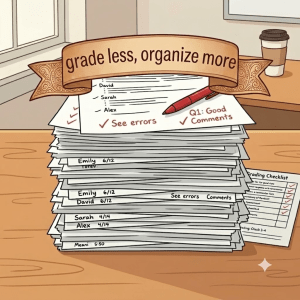
One of my peers, bless her heart, was rolling a literal handcart piled high with student worksheets and notebooks. My other friend had a bag weighing down each shoulder on top of her backpack and lunchbox. And my fourth companion? Just a lunchbox and nothing else.
As we walked to our cars, we got to talking about that age-old dilemma: To grade at home or not to grade at home? Keeping on top of the gradebook is arguably the single heaviest beast in education. I casually asked the group, “Well, how many things are y’all grading in a week?”
One of our younger coworkers sighed and said she feels like she has to touch and mark every single piece of paper, because if she doesn’t, the kids simply won’t turn anything in. Then my friend with just the lunchbox shrugged and said, “Well, I only grade two things a week, and one of ’em is always a quiz.” I laughed and said, “Wow, that’s wild!”—knowing full well that he teaches high school math, which is a completely different solar system compared to the English lens.
But it made me reflect. As a younger teacher, I used to feel that exact same pressure. I thought I needed to put a red pen to every single syllable a student produced. Today, between department chair duties, club sponsorships, 504s, IEPs, and collaborative meetings, who has the time to live like that?
About ten years ago, I made an active choice: if I’m going to survive this profession with my sanity intact, I have to be incredibly picky about what I grade, how I grade it, and how I protect my boundaries. Here is exactly how I tame the grading monster without ever wheeling a crate of papers to my car.
1. The 3-Day Turn-In Window & The Tutoring Cutoff
Deadlines are real, but chasing late work all semester will age you overnight. To keep my sanity intact, I utilize a strict 3-day deadline window for major assignments. I layout the options clearly for my students:
- Day 1: Turn it in early? You get a pool of bonus points.
- Day 2: Turn it in on time? You get your regular, fair grade.
- Day 3: Turn it in on the final window day? You receive late points deducted.
Once that 3-day window slams shut, I will not accept the assignment. Period. If a student wants to turn it in after the deadline, their grade stays a zero until they physically attend my after-school tutoring sessions (which is a requirement at my school). I will only hand-grade the late assignment while they are sitting right in front of me.
This completely eliminates thick stacks of late work appearing on my desk weeks later. Because we are on a block schedule with three classes a day—and our district runs on a 6-week-on, 1-week-off semester system—this window is incredibly manageable for my rosters. Even my peers on A/B schedules with higher student numbers have adopted this window system and found it completely changes the game.
2. Preventing the Zero: The “Halfway Point” Spot Check
We all know zeros are academic quicksand for a student’s average. To keep kids moving forward, I actively work to avoid them by using Halfway Point Grades.
Let’s say we are working on a robust assignment in class on Monday, Tuesday, and Wednesday, with the turn-in window opening Thursday. On Wednesday, I will do a lap around the room and spot-check everyone’s progress without providing deep feedback. If they are exactly where they need to be, I give them a temporary 25 or 50 points in the gradebook to reflect that 25% or 50% of the task is physically present and attempted.
This ensures that even if they stumble across the finish line or turn it in on the late-penalty day, I can see their attempt. Now, if a student treats class time like a social hour and puts forth zero effort, they receive an Incomplete Penalty—which I call a “yellow card,” just like in soccer. Students only get a limited number of yellow cards a semester. Once they hit their limit, it triggers an immediate phone call home to Mom and Dad to figure out a plan.
If they genuinely struggle with the skill, they can use a Redo Ticket. I allow one redo on small formative assignments, and up to two redos on essays (quizzes and tests are strictly limited to one redo). But to cash in that ticket, they have to come see me in tutoring.
3. The Feedback Code System (Save Your Ink!)
There is a massive debate in the pedagogical sphere about grading for completion versus grading for mastery. Your district’s policy will always dictate your baseline, but regardless of where you stand, one truth remains: Feedback is the entire point of grading. It is what actually causes a student to grow.
To give rich feedback without writing a novel on 90 different essays, I use a Feedback Code System I learned years ago from a brilliant senior teacher. I have a master chart of generic coded comments that my students keep clipped inside their binders or interactive notebooks.
- Instead of handwriting “Please elaborate more on this textual evidence and connect it back to your thesis statement,” fifty times, I simply circle the paragraph and write E2.
- If they forgot a name, it gets an N1.
- Mechanical or capitalization errors get a specific shorthand code.
I’ve linked my master [Feedback Code Chart System Here] for y’all to copy and adjust for your own rooms. It takes a second for the kids to get used to looking up their codes, but it speeds up my essay-grading timeline by half!
4. Going Old School: The Paper Gradebook Boundary
Call me old-fashioned, but I am fiercely loyal to a paper gradebook. I’ve linked my top 3 below, if you want to check them out, though you can easily print a blank lined roster directly from your district’s online portal.
Paper Gradebooks I use:
- # 1 – House of Doolittle Class Record https://www.amazon.com/dp/B0017D9JCE/?coliid=I13NQWM48H6UYP&colid=38W18YQ588FEM&ref_=list_c_wl_lv_ov_lig_dp_it&th=1
- #2 – Elan Publishing Company Class Record (has a fold out page and slots for 50 students! https://www.amazon.com/dp/B00Q4V0NYC/?coliid=I29HA0I0RCCZU4&colid=38W18YQ588FEM&psc=1&ref_=list_c_wl_lv_ov_lig_dp_it
- #3 – Sunee Teacher Class Record (they are okay, but the spiral is too large for my liking) https://www.amazon.com/dp/B0C1GHY6QD/?coliid=I3OBLDJT56A214&colid=38W18YQ588FEM&ref_=list_c_wl_lv_ov_lig_dp_it&th=1
In my 19 years in the classroom, I have watched digital platforms crash, updates delete entirely entered columns, and sync errors cause absolute chaos. A paper backup ensures my data is safe, and it lets me quickly answer a student tableside without opening a laptop. I have a very specific system for keeping my book organized:
- Pencil for Grades: I always write student scores in pencil. If they use a Redo Ticket in tutoring, I can cleanly erase it and update their mastery.
- The Missing Circle: If an assignment is missing, I draw a bold circle in the empty box. The next day, I can glance down and immediately say, “Hey friend, I’m missing this from you. Make sure it gets in the window.”
- Highlighter Transfers: When it is time to transfer my paper marks into our official electronic LMS, I use a rotating cycle of three different colored highlighters across the rows. Once a line is highlighted, I know it has been officially entered online. This keeps my early bird bonus points, regular window scores, and late-penalty tracks completely distinct.
Respecting Your Peace: The Weekend Boundary
People outside of education love to talk about how teachers “get summers off” and have every weekend free. What they don’t see are the 14-to-15 hour days teachers pull during our 189-day contracts just to stay afloat, leaving us completely depleted by July. To combat that exhaustion, you have to build walls around your personal time.
I have two strict scheduling rules that protect my work-life balance:
- I stay late exactly twice a week. One afternoon is purely dedicated to sorting my planning period folders and clearing out any grading that accumulated. The second afternoon is my required tutoring day, where I live-grade student work right in front of them so they can watch their scores improve in real time.
- I enter grades on Sundays. I set aside exactly two hours on Sunday afternoon to input my highlighted paper grades into the electronic system and shoot out my weekly parent newsletter. Yes, I teach high school, and yes, I still send a weekly newsletter ahead of the upcoming week! The parents absolutely love the communication, and it keeps everyone on the same page.
Also, if you have not checked out my GRADING SUPPLIES LIST of resources from AMAZON: here is the link!
Once that window closes, my laptop is shut. I do not check emails, and I do not answer school calls after hours.
When you walk out of the building next week, look at what you are carrying. If you are wheeling a handcart or balancing bags on both shoulders, take a deep breath and evaluate your system. Are you grading for the sake of grading, or are you capturing the most robust, meaningful assignments to check for mastery? Keep it light, keep it streamlined, and leave the crates in your classroom.
Until next time, may the odds be ever in your favor, and y’all take care!


Leave a comment