Howdy, y’all!
Welcome back to our ongoing journey through the new Georgia ELA standards! In our previous posts, we talked about how these new standards are nested inside one another like a set of shiny Russian nesting dolls. Today, for Part 3 of our series, we are cracking open the nesting dolls to take a deep dive into one specific domain category that is causing a lot of chatter in department meetings across the state: The Texts Domain.
When you look at the way the Department of Education has laid out this domain, the structure from top to bottom actually reminds me less of a rigid checklist and more of how a fine cuisine is organized—you have your core ingredients, your preparation styles, and your distinct flavors all working together to create a full experience.
The Texts Domain is broken down into five distinct Big Ideas:
- Context
- Structure & Style
- Techniques
- Research & Analysis
- Periods & Movements
But honey, let me tell you, this domain is a whole different beast than what we are used to dealing with in our traditional classrooms. It completely redefines what we legally have to recognize as a “text.”
Redefining the Page: What is a “Text” Now?
For generations, when an English teacher said the word text, we meant a novel, a short story, a poem, or a hardback essay. But under these new standards, Georgia has officially expanded the definition. A text is now defined as anything that communicates a message to an audience.
This means we are explicitly incorporating multimodal texts into our daily instruction. A text can now look like:
- A traditional novel or textbook chapter.
- An Instagram reel or a TikTok video.
- A blog post or a Facebook update.
- A YouTube video or an auditory podcast.
- Even data-driven graphs, infographics, and charts!
This multimodal approach affects every single grade level from kindergarten all the way through senior year. What you are actually doing with these formats simply depends on your grade level’s depth of knowledge and the specific Big Idea you are targeting.
The Progression: It Starts Sooner Than You Think!
As students advance from grade level to grade level, they are built to get continuous exposure to these standards, steadily sharpening their skills as they grow. But if you think “multimodal” is a buzzword reserved just for us high school teachers trying to analyze media literacy, think again.
The word multimodal strictly starts appearing in the standards as early as second grade! Down under the second-grade standards for Context, the expectations explicitly require multimodal text creation using two or more modes. Little eight-year-olds are already being asked to intentionally combine visual elements, print, or audio to deliver a message.
Getting a firm handle on what this term means is absolutely essential for understanding how the Texts Domain is going to reshape your classroom mapping.
Integrating the Multimodal Shift into the Big Ideas
When we look at those five distinct Big Ideas, we have to deeply consider how multimodal texts fit into each and every one of them. Multimodal communication is truly the core axis around which our entire English-teaching lens is shifting.
What does that mean for us in the classroom? It means the days of strictly layered, traditional thematic-based units are changing. When you sit down to design your thematic units now, you have to intentionally map out exactly which modes of text you will utilize to help your students in the 6-12 realm meet the specific benchmarks for Context, Structure & Style, Techniques, Research & Analysis, and Periods & Movements.
Historically, courses like American Literature or World Literature have been anchored entirely by chronological time periods, pacing students meticulously from early foundational texts straight through to the modern era. Moving forward, some courses aren’t necessarily going to be taught that way anymore.
The Resource Reality: Textbooks vs. Tech
How this actually plays out on the ground is going to depend heavily on your specific school district’s directives and your local textbook adoptions.
The reality across the state of Georgia right now is a mixed bag:
- The Traditionalists: Some school districts are still clinging to those big, thick, traditional print textbooks from publishers like HMH or Prentice Hall.
- The Digital-First Districts: Other districts are shifting toward a solely online method, leaning heavily into a Learning Management System (an LMS—which is just the digital classroom platform your district uses to host assignments and grades, like Canvas, Google Classroom, or Schoology) because they have moved to a 1:1 ratio where every single student is assigned their own device.
Now, let’s be real: going completely digital opens up a massive can of worms. Figuring out whether a student’s digital work is legitimately theirs, debating if we are overusing or underutilizing AI, and analyzing digital testing footprints is a whole other beast. Protecting the integrity of products like student essays and short stories in a digital world is a massive conversation—but that is a post for another time!
Right now, the bottom line is that your school district is going to dictate your baseline teaching resources. They will tell you whether you are using a physical book, a blended digital-print model, or a solely digital source. From there, what you use to supplement, adapt, and leverage for your local school is going to depend on the guidelines handed down by your department chair or your district-level English lead.
Deep Dive: A 19-Year Veteran’s Lens on Big Idea #1: Context
As we look at how to actually implement this, I want to filter our discussion specifically through the 6-12 grade bands. That is the arena where I have spent my 19-year career—spending a decade in middle school before transitioning up to high school corridors. Let’s look at how we navigate the very first Big Idea of the Text Domain: Context.
First, what on earth does context actually mean under these standards? Simply put, context is the situation in which the texts are being used.
When you look at the framework for Context, the standards are divided into two primary groupings:
- Purpose and Audience
- Authors and Speakers
When we put on our English teacher glasses to look at a text, we are asking: Who wrote it? Who said it? Who are we speaking to? And why did they choose to craft or speak this message in this exact way? Let’s break down how this changes as our kids grow up.
Standard Grouping 1: Purpose and Audience
If you track this standard group from 6th grade up to 12th, you’ll see a beautiful, albeit challenging, ladder of rigor.
In 6th through 8th grade, the standards focus on identifying multiple purposes within a single text and determining how those purposes target a specific audience.
How I’d teach it in Middle School: If I am planning a middle school unit, I am going to pull a rich variety of texts where kids can see multiple things happening at once. I might choose a magazine article that includes data graphs and charts. This allows my logical, math-minded students to analyze the informational purpose of the graphics, while simultaneously reading an argumentative editorial side that relies on emotion to sway public opinion. The students have to put on an analytical lens to identify, determine, and decide: What are the different purposes here, and how do they connect to the author’s target audience?
When our kids cross the threshold into high school (9th-12th), the standards shift. We move away from general multi-purpose texts and dive straight into texts that fit within specific disciplinary, personal, or technical purposes.
- Disciplinary Texts: These are writings specific to a certain academic field. Think of a text written strictly for science or history, like a non-fiction book focusing on a single historical event, or a research-based journal article featuring a complex case study with results and findings. The rigor here increases naturally because the Lexile level jumps.
- Personal Texts: These are pieces deeply personal to the creator. It could be something as intimate as a poem, or as expansive as a critique of a visual work of art.
- Technical Texts: These are documents written for an incredibly specific, functional purpose. Think of technical operating manuals, or historically, our own founding documents like the Constitution and the Bill of Rights. Even data-heavy charts, like a GDP timeline, function as technical texts.
As a high school teacher, you have to be incredibly picky about what you choose to use within your units. You are analyzing how voice, tone, diction, and word choice impact how an audience receives the piece, and speculating on why the author made those specific stylistic choices based on the situation behind the text.
And don’t forget the multimodal mandate! Across the entire 6-12 band, students must analyze or create multimodal presentations and texts that serve more than one purpose or audience using clearly identifiable features.
This is where you get to introduce modern brilliance without throwing away your traditional resources. Think about using a TED Talk where the speaker utilizes a digital slide deck with charts alongside screenshots of a social media thread. Or leverage a compelling storytelling podcast. You don’t have to abandon the core texts you love or the digital platforms your district mandates; you just have to change the angle from which you select and pair them.
Standard Grouping 2: Authors and Speakers
The second half of the Context puzzle focuses entirely on the writers and the speakers themselves. If you look closely at the standards progression from 6th to 12th grade, there are subtle, nuanced shifts that change the game each year.
Look at the middle school jump:
- 6th Grade: Focuses on identifying two or more perspectives within a single text.
- 7th Grade: Focuses on determining the prevailing perspective and distinguishing it using corroborating evidence.
- 8th Grade: Focuses on analyzing varying perspectives on a topic across a variety of texts.
Once you hit 9th through 12th grade, the standards look remarkably uniform across the band, echoing that 8th-grade language: analyzing varying perspectives on a topic across a variety of texts.
In my opinion, this uniformity actually makes our job a whole lot easier from 8th grade up to graduation. It means we can establish a big, overarching “bucket idea” for a topic and pull from an entire network of voices.
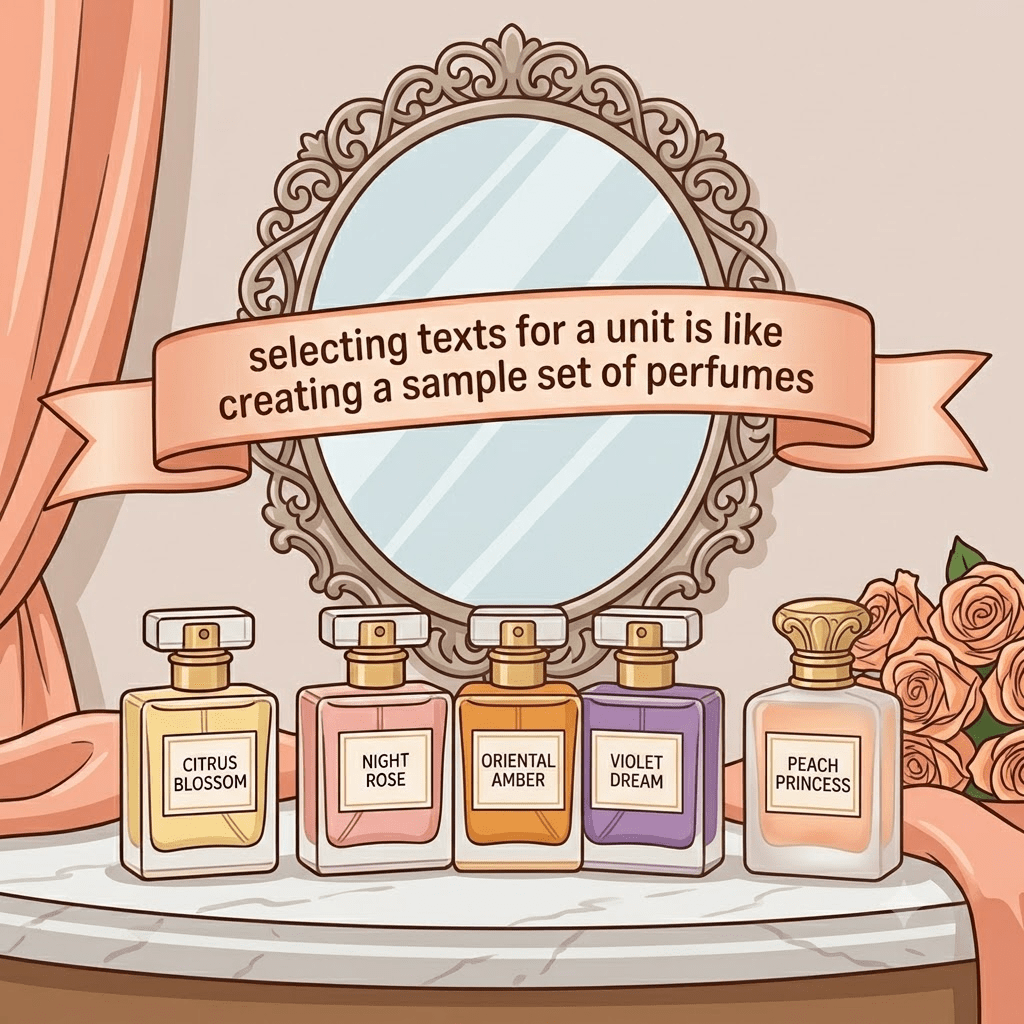
Take a classic topic like The American Dream. You can create a rich unit exploring whether that dream is truly achievable in modern society. To address the standards, you aren’t just looking for a single theme; you are building a sample set of the broader body of knowledge surrounding that topic.
Think of it like designing a luxury perfume sample set. There are a million fragrances out there, but you don’t select them randomly or strictly by the historical era they were manufactured. Instead, you build a sample set based on complementary and contrasting notes:
- Your first scent might have a heavy note of vanilla.
- Your second scent shifts the spotlight to a robust note of coffee, keeping vanilla strictly in the background.
- Your third scent flips the script entirely to a light, airy lavender.
- Your final scent goes in the complete opposite direction with a deep, dramatic rose.
This sample set is exactly what you are building for your students. You are gathering a diverse collection of text shapes, sizes, and mediums so they can analyze how different perspectives fit into the grander conversation.
How I’d teach it in High School: If we are reading The Great Gatsby, we don’t just stop at Fitzgerald’s pages. To satisfy the standard’s need for a body of knowledge, we look at the lines connecting multiple texts. We ask: How does Gatsby fit into the concept of the American Dream? How does Gandhi’s speech on civil disobedience correlate to that same concept? How does a poem by Langston Hughes reframe it? And how does a modern infographic of Census Bureau data or a GDP chart showing economic mobility influence or alter our understanding of the whole conversation?
Suddenly, your students are analyzing a fiction novel, a historical speech, a poem, a digital infographic, and maybe even a documentary or a YouTube video. They are drawing lines of correlation, mapping relationships, and discovering how modern and traditional texts are situated within the human experience of a single topic.
Peachy Keen Takeaways for Your Planning
As you sit down with your planning calendar to tackle the Texts Domain and the concept of Context, keep these three veteran rules of thumb in mind:
- Know Your Multimodal Options: Expand your definition of text. Start looking for podcasts, TED Talks, graphic novels, and data charts that can sit alongside your literary pieces.
- Start with Your District Mandates: Before you go hunting across the wild depths of the internet, look closely at what your school or district has already adopted—whether it is a physical textbook or a specific LMS platform. They have already done the heavy lifting of pulling a large sample set together for you. Start there, and then thoughtfully supplement.
- Think “Bodies of Knowledge,” Not Just Themes: When the standards mention a “topic,” train your brain to think of a grander body of knowledge. Look for texts that agree, texts that disagree, texts that define, and texts that showcase data. Give your kids the puzzle pieces they need to build the full picture.
In our next post, we are going to dig a little deeper into the next major area of the Text Domain: Structure and Style. Until then, find some time to turn off your classroom lights, close your door, and protect your planning peace.
What topic are you planning to build a text sample set for this semester? Drop your ideas in the comments below, and let’s collaborate!
Until next time, y’all take care.


Leave a Reply